About the Institute
The Confucius Institute at Düsseldorf was established on December 6, 2006, making it the third Confucius Institute in Germany and the first in the state of North Rhine-Westphalia. Located in the heart of the Rhine-Ruhr metropolitan area—one of Germany’s most economically dynamic regions and home to a dense concentration of Chinese-invested companies and international organizations—the Institute has long served as a hub for Sino-German business, cultural, and educational exchange.
Following a restructuring of its operating model, the Institute was formally registered in Germany in July 2024 as a non-profit association (German: eingetragener Verein). Its Board of Directors is chaired by |Prof. Dr. Meng Lingqi, Head of the Chinese Department at SDI Munich, and vice-chaired by Petra Schnell-Klöppel, former principal of the Bölsche-Gymnasium. The current German Director is Peter Hartges, previously responsible for China cooperation programmes at RWTH Aachen University.
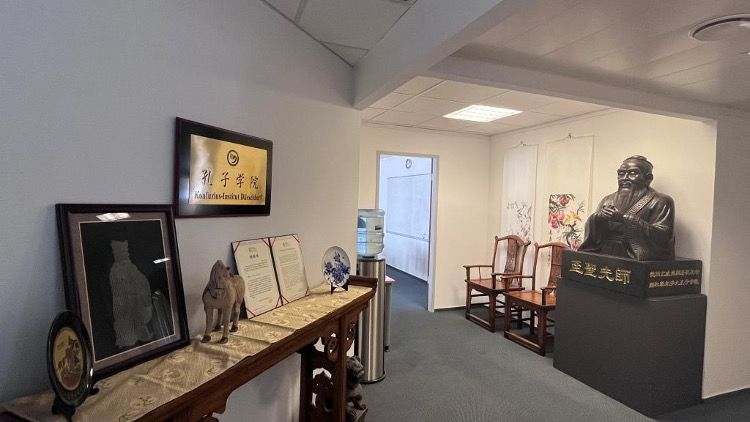
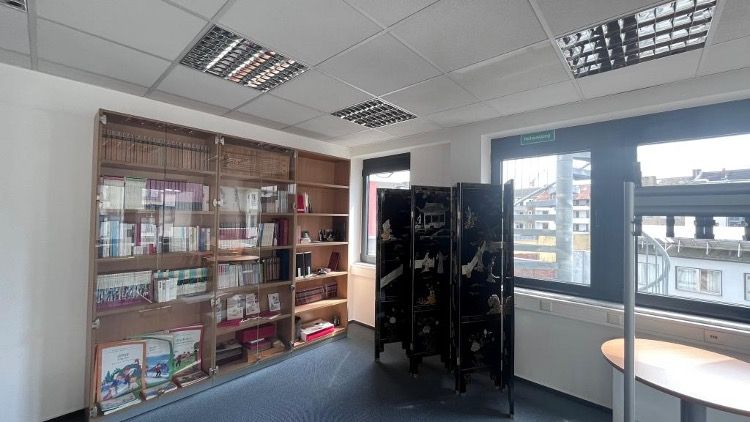
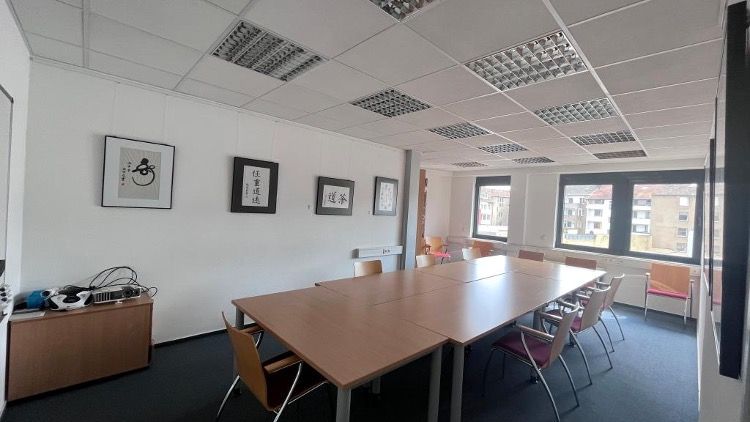
The Institute’s premises include classrooms, a multifunctional event space, and administrative offices, supporting a broad range of language, cultural, and advisory activities. It currently enrolls approximately 500 students per year, serving learners from across North Rhine-Westphalia and the surrounding region. Over nearly two decades of operation, the Institute has served more than 10,000 learners in total.
Programs and Activities
Chinese Language Teaching & Examinations
The Institute offers Chinese language courses at beginner, intermediate, and advanced levels, as well as a range of specialist programs including Business Chinese, HSK examination preparation, practical spoken Chinese, reading comprehension, and Chinese character writing. Tailored language and intercultural training courses are also available for local schools, corporations, and cultural organizations.
Teaching at the Institute integrates language learning with hands-on cultural experience. The Language + Culture Workshop model has become a defining feature of the Institute’s pedagogy, with dedicated sessions in Chinese calligraphy, ink painting, guzheng, and tea ceremony—formats designed to engage learners through immersion rather than instruction alone.
Three HSK examination sittings are held each year, serving approximately 300 candidates annually. The Institute also administers two sittings of the International Chinese Language Teacher Certificate (CTCSOL) examination each year, covering both written and oral components.
Faculty Development & Academic Research
Drawing on the curriculum resources of Beijing Foreign Studies University and the pedagogical expertise of its German partner institutions, the Institute maintains an ongoing program of course development, teaching material review, and case-study documentation. Faculty are supported in attending pre-service training, in-service workshops, peer observation sessions, and thematic seminars, with a focus on strengthening competencies in course design, classroom delivery, intercultural communication, and program management.
Cultural Programs
Düsseldorf has one of the largest communities of Asian residents in Germany, and the Institute plays an active role in the city’s intercultural life. Approximately 20 cultural events are organized each year, reaching tens of thousands of participants across North Rhine-Westphalia and beyond.
Flagship events include the Chinese New Year Celebration, the Mid-Autumn Festival, and a series of seasonal cultural experiences tied to the traditional Chinese calendar. Recurring workshops in calligraphy, ink painting, Chinese music, and cultural lectures complement the annual program. A particularly popular format combines cultural presentation with hands-on craft activities—sessions on tea ceremony, paper-cutting, Peking opera face painting, and solar term traditions have drawn consistently strong attendance.
The Institute is a long-standing participant in major regional events such as the China Festival in North Rhine-Westphalia, and maintains close working relationships with local government bodies, cultural institutions, and schools.
Signature Initiatives
The Institute has developed a distinctive identity centered on accessibility, experiential learning, and community relevance. Recognizing the relatively limited presence of academic Chinese language programs at local universities, the Institute has deliberately broadened its reach beyond traditional academic audiences—placing cultural experience and practical language skills at the core of its offer.
In response to Germany’s growing interest in Germany’s China Competence initiative (German: China-Kompetenz), the Institute has expanded its outreach into secondary schools, delivering introductory Chinese language sessions and cultural workshops that bring Chinese language education into the primary and secondary curriculum.
Leveraging Düsseldorf’s position as Germany’s foremost center for Chinese business activity, the Institute is also developing program pathways in the areas of professional Chinese language skills and Sino-German business communication, building towards a platform that connects language learning with career development and commercial exchange.
Looking Ahead
The Institute’s development priorities focus on deepening its local roots and long-term sustainability. Key areas of work include building stable, long-term partnerships with secondary schools in the region; strengthening collaboration with Chinese-invested enterprises and local institutions; expanding digital outreach and social media engagement; and developing integrated platforms for youth exchange and people-to-people engagement between China and Germany.
Contact
German Director: Peter Hartges
Chinese Coordinator: ZHENG Wanting
Email: hartges@konfuzius-duesseldorf.de | zheng@konfuzius-duesseldorf.de
Website: www.konfuzius-duesseldorf.de
Phone: +49 211 416285-42
Address: Graf-Adorf-Str. 63, 40210 Düsseldorf, Germany